North America is 9,000 kilometers wide, four time zones deep, and three television countries in one — and the coverage question is whether one subscription reaches all of it. From the Atlantic coast of Nova Scotia to the Pacific coast of Baja California, the channels change, the sports change, and the prime time changes, but the login does not have to. This guide maps IPTV coverage across North America by region and time zone, so you can see what one subscription delivers wherever you watch from. The ranking behind the map is in the best IPTV North America guide.
IPTV across North America: the coverage map
The coverage map has three layers. The United States layer runs from New York to Los Angeles: the big four networks ABC, CBS, NBC and FOX, the cable news channels, ESPN, TNT Sports and the Spanish-language channels Univision, Telemundo and TUDN. The Canadian layer runs from Toronto to Vancouver: CBC, CTV, Global, TSN, Sportsnet, RDS and TVA, with The National, Hockey Night in Canada and the CFL. The Mexican layer runs from Tijuana to Cancún: Las Estrellas, Azteca Uno, Canal 5, TUDN and Distrito Comedia, with the novelas and Liga MX. A service that covers all three layers earns the name North American; a service that covers one is a national service.
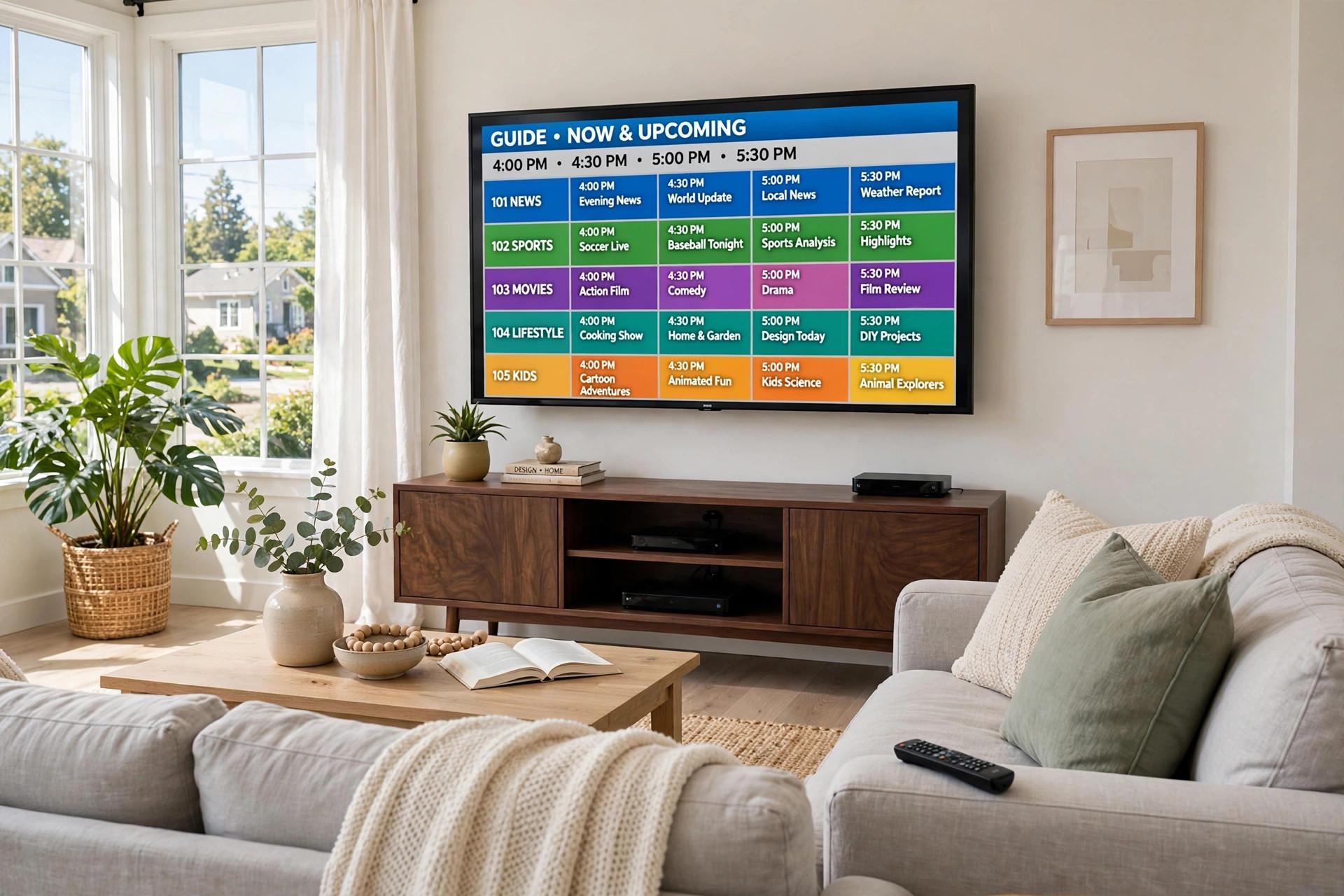
The VOD library is the second half of the map: 185,000 movies and 49,000 series on Premium, with the new premieres, the complete box sets and the subtitles in English and Spanish. The EPG is the third half — it shows the schedules of all three countries in your time zone, so the evening plans itself across the border. And the multi-device plans are what make it work for a family spread across the map: Premium for 12 months costs $159.99 for two devices, $224.99 for three and $269.99 for four, all watching at the same time.
Time zones: one evening, four clocks
Time zones are the practical side of coverage across North America. A 9:30 p.m. novela in Mexico City is 10:30 p.m. Eastern in New York and Toronto, 9:30 p.m. Central in Chicago and Houston, 8:30 p.m. Mountain in Denver, and 7:30 p.m. Pacific in Los Angeles and Vancouver. A 7 p.m. Eastern Hockey Night in Canada game is 4 p.m. in Vancouver. A 3 p.m. Eastern Champions League kickoff is noon in Los Angeles. The EPG on your IPTV app shows the times in your own zone, so a viewer in New York and a viewer in Los Angeles see different clocks for the same match — and neither misses it.
The viewing habits follow the clocks. The East Coast watches the evening news at 6:30 p.m. and the prime time at 8 p.m.; the West Coast watches the same shows three hours later, and the sports at 4 p.m. instead of 7 p.m. The Friday Liga MX doubleheader at 8 p.m. and 10 p.m. Eastern is 5 p.m. and 7 p.m. Pacific, which is why the West Coast audience peaks earlier. The coverage test is the EPG: a real North America service shows the schedules of all three countries in your time zone, not just the Eastern feed.
East, Central, Mountain and Pacific: the regional habits
The East Coast watches the earliest prime time in the continent: the 6:30 p.m. news, the 8 p.m. dramas, the 10 p.m. news, and the Saturday Hockey Night game at 7 p.m. The Central time zone — Chicago, Houston, Dallas — watches the same shows an hour earlier, and the Mexican audience in Texas watches the Liga MX doubleheader at 7 p.m. and 9 p.m. local time. The Mountain zone — Denver, Phoenix, Calgary — splits the difference, and the Pacific zone — Los Angeles, San Francisco, Vancouver — watches the prime time at 8 p.m. local, three hours after New York.
The regional sports habits follow the same map. The East Coast follows the NFL on FOX and CBS on Sunday at 1 p.m.; the West Coast follows the same games at 10 a.m. The Canadian West Coast follows the Vancouver Canucks on Sportsnet Pacific, while the East follows the Maple Leafs on Sportsnet Ontario. The Mexican audience in Los Angeles follows Chivas and América on TUDN at 5 p.m. Pacific on Fridays. One subscription has to serve all four zones, and the regional feeds — the Sportsnet regions, the Fox Sports regions — are what make it work. The three-country comparison is in the IPTV USA Canada Mexico guide.
| Time zone | Prime time | Liga MX Friday | Hockey Night |
|---|---|---|---|
| Eastern | 8 p.m. | 8 p.m. / 10 p.m. | 7 p.m. |
| Central | 7 p.m. | 7 p.m. / 9 p.m. | 6 p.m. |
| Mountain | 7 p.m. | 6 p.m. / 8 p.m. | 5 p.m. |
| Pacific | 8 p.m. | 5 p.m. / 7 p.m. | 4 p.m. |
| Mexico City | 9:30 p.m. novela | 7 p.m. / 9 p.m. | — |
| Hawaii | 5 p.m. | 3 p.m. / 5 p.m. | 2 p.m. |
Sports across the map: Friday Liga MX to Sunday NFL
The sports calendar is the reason one subscription beats three across the map. Friday night belongs to Mexico: the Liga MX doubleheader on TUDN at 8 p.m. and 10 p.m. Eastern, 5 p.m. and 7 p.m. Pacific. Saturday belongs to Canada and the United States together: Hockey Night in Canada on CBC and Sportsnet at 7 p.m. Eastern, the MLS slate at 7:30 p.m., and the Liga MX prime-time match. Sunday belongs to the United States: the NFL on FOX, CBS and NBC, with the late games running into the evening on the East Coast and the afternoon on the West Coast.
The tournaments where the map meets are the Gold Cup every two years and the Leagues Cup every July and August, when all 30 MLS clubs play the 18 Liga MX clubs. The ranking test for sports is a Saturday: at 7 p.m. Eastern the Hockey Night game is running, at 7:30 p.m. the MLS slate kicks off, and at 8 p.m. the Liga MX prime-time match starts on TUDN. A service that holds all three at once, in Full HD or 4K, earns its place. The full sports comparison is in the IPTV for Americas sports fans guide.
IPTV across North America prices and the free trial
Price is straightforward. Best IPTV America Basic costs $14.99 for one month, $24.99 for three months, $39.99 for six months and $59.99 for 12 months, with 10,000+ channels and 80,000 movies and series in HD and Full HD. Premium costs $19.99 for one month, $49.99 for three months, $79.99 for six months and $99.99 for 12 months, with 57,000+ channels, 185,000 movies and 49,000 series, 4K and 8K quality, and all sports and pay-per-view. The 12-month Premium plan works out to about $8.33 a month.
Every plan starts with the same free 24-hour trial, and the trial includes all three countries — there is no stripped-down version. Start it on a Friday evening, watch the Liga MX match and the novela, then the Hockey Night game on Saturday and the NFL on Sunday, wherever in North America you watch from. If all three countries hold through the weekend, subscribe on WhatsApp and the same login keeps working. Payment is by card in US dollars through Stripe, and the refund policy covers 7 days, or 30 days on yearly plans. Compare the plans on the plans page.
The border test: watching from both sides
The border test is the simplest test here and the most revealing: start the trial in one country, finish it in another, and the service should work the same in both. The snowbird starts it in Toronto in October and finishes it in Florida in January; the American retiree starts it in Texas and finishes it in Mexico City; the executive starts it in New York on Monday and finishes it in Montreal on Friday. The login does not care which side of the border you are on, and neither does the guide — the EPG shows the times in your own zone, wherever you are.
The channels behind the border test are the three national lineups in one list: the US networks ABC, CBS, NBC and FOX, the Canadian channels CBC, TSN, Sportsnet and RDS, and the Mexican lineup of Las Estrellas, Azteca Uno and TUDN. The favorites row travels with the login — FOX, CBC, TUDN and Las Estrellas — so the evening is the same on both sides of the border. The multi-device plans cover the house on both sides: Premium for 12 months costs $159.99 for two devices and $269.99 for four, all watching at the same time.
The setup behind the border test is the Firestick in the suitcase. Pack it, plug it in on the other side, log in with the same details, and the favorites row is waiting. The same works on a Smart TV, an Android phone or an iPhone — the login travels, the channels travel, and the EPG converts the time zones. The full steps for all 13 devices are on the installation guide, and the cross-border viewing guide is in the best IPTV for cross-border viewing article.
The price verdict for the border test follows the coverage verdict. Two cable bills — one on each side of the border — cost several times the price of one IPTV subscription, and still miss the sports. Premium at $99.99 a year works out to about $8.33 a month, which is less than a single pay-per-view boxing night on its own. The full price comparison is on the plans page, and the three-country version is in the IPTV USA Canada Mexico guide.
Verify the border test free. Message us on WhatsApp and we activate a free 24-hour trial that works on both sides of the border — no location lock, no card details needed. Start it at home, finish it at the winter house, and watch the same channels in both places. If the service holds on both sides, the test passes — and the same login keeps working when you subscribe.
- Coverage runs from Nova Scotia to Baja California in one login.
- Four US time zones plus Mexico City — the EPG converts them all.
- East Coast: 8 p.m. prime time; West Coast: the same shows at 8 p.m. local.
- Regional feeds: Sportsnet Ontario, Sportsnet Pacific, Fox Sports regions.
- Friday Liga MX, Saturday hockey, Sunday NFL — one calendar.
- Multi-device: Premium 4 devices costs $269.99 a year.
- Test over one Friday-to-Sunday weekend, in your time zone.
- Free 24-hour trial includes all three countries, no card needed.
- Border test: start the trial in one country, finish it in another.
- Firestick travels: pack it, plug it in, log in.